

Views: 426 Author: Site Editor Publish Time: 2026-02-23 Origin: Site


Determining the exact power requirements for a hydraulic pump is the difference between an efficient, high-performing system and a costly mechanical failure. If you undersize your prime mover, the system stalls under load. Oversize it, and you waste energy and capital.
Whether you are designing a custom industrial power unit or replacing a motor for a high pressure application, the math remains constant. This guide breaks down the variables, the formulas, and the practical considerations involved in calculating the horsepower (HP) needed to drive your hydraulic pump effectively.
To find out how much horsepower you need, you must look at three primary factors: flow rate, pressure, and mechanical efficiency. The relationship between these variables is linear. If you double the pressure while keeping the flow the same, you double the power demand.
The standard imperial formula used by engineers worldwide is:
HP = (GPM × PSI) / (1714 × Efficiency)
In this equation:
GPM is Gallons Per Minute (the flow rate).
PSI is Pounds per Square Inch (the operating pressure).
1714 is the constant that converts these units into horsepower.
Efficiency (total efficiency) accounts for energy lost as heat or through internal leakage.
No hydraulic pump is 100% efficient. Energy is lost due to friction between moving parts and internal fluid bypass. For a high-quality low noise vane pump, total efficiency usually ranges between 85% and 90%. If you ignore efficiency in your calculation, your motor will likely overheat or trip the breaker when the system hits maximum pressure.
| Pump Type | Typical Efficiency Range | Common Application |
| Two stage Gear Pump | 75% - 85% | Log Splitters, Mobile Equipment |
| Low noise vane pump | 80% - 92% | Industrial Machinery, Plastic Injection |
| Variable displacement Piston | 90% - 95% | High-pressure aerospace, Heavy Construction |
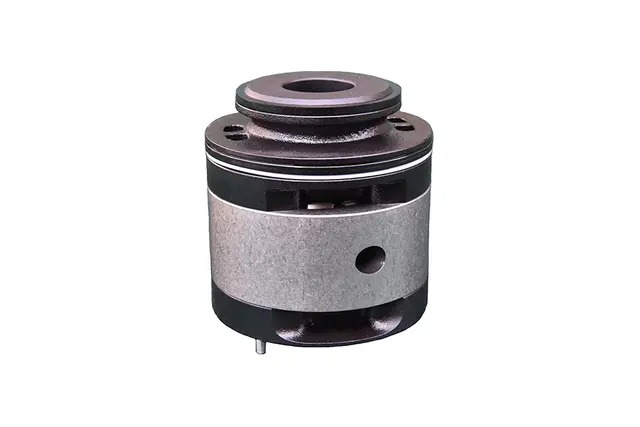
The "load" on a hydraulic pump isn't just the weight it lifts; it is the resistance to flow. When you ask how much horsepower you need, you are really asking how much work the fluid must do per unit of time.
When operating a high pressure system—often defined as anything above 3,000 PSI—the mechanical stress on the pump increases. Every internal gap allows a tiny bit of fluid to slip back to the inlet. To maintain the same output at higher pressures, the prime mover must work significantly harder. For instance, a 12v dc electric pump might easily move 2 GPM at 500 PSI, but it might stall completely if the pressure requirement jumps to 2,500 PSI without a corresponding increase in torque.
Flow is directly related to the displacement of the hydraulic pump and the speed (RPM) at which it turns. If you run a pump faster to get more GPM, your horsepower requirement climbs proportionally. It is a common mistake to think that a "small" pump doesn't need much power. If that small pump is geared to move fluid at high velocity against heavy resistance, it will demand significant HP.
Not all pumps demand power in the same way. The architecture of the unit changes the "power curve."
A fixed displacement hydraulic pump moves the same amount of oil every rotation. Therefore, the horsepower requirement increases steadily as pressure builds.
However, a variable displacement pump is more sophisticated. These pumps can "de-stroke" or reduce their flow once a certain pressure is reached. This is a massive advantage for energy savings. You might use a 20 HP motor to achieve high flow at low pressure, and then the pump adjusts so that at high pressure, it only draws 5 HP by reducing the flow.
In many DIY or mobile applications, a two stage pump is used to save on engine size. These units have two internal pumping sections.
High Flow/Low Pressure: Both sections work together to move a cylinder quickly.
Low Flow/High Pressure: Once the system hits a specific PSI (the "kick-down" pressure), the high-flow section bypasses to the tank, and only the small section continues to pump.
This allows a small 5 HP gas engine to perform work that would otherwise require a 15 HP engine if it were a single-stage hydraulic pump.
When calculating power for a hydraulic pump, the source of that power matters. Electric motors and internal combustion engines have very different torque curves.
Electric motors, including a 12v dc electric setup, can handle "breakdown torque" or momentary overloads. You can often "overwork" an electric motor by 10-25% for very short cycles. If your high pressure spike only lasts half a second, you might not need to size the motor for that peak.
Internal combustion engines are rated at their peak BHP (Brake Horsepower), usually at high RPM. Unlike electric motors, they will simply stall if the load exceeds their capacity. As a rule of thumb, you should size a gas engine at roughly 1.5 to 2 times the calculated theoretical horsepower to ensure it has enough torque to keep the hydraulic pump turning under load.
Pro Tip: Always check the torque-speed curve of your engine. A hydraulic pump requires torque to start under pressure, and many engines produce very little torque at low idle.
As a leading manufacturer in the fluid power industry, we understand that horsepower isn't just about raw strength; it’s about system harmony. At Keister, our factory focuses on precision-engineered low noise vane pump solutions that maximize every bit of input horsepower.
We operate a state-of-the-art facility where we prioritize the "total cost of ownership" for our B2B partners. When we design a hydraulic pump, we don't just look at the PSI; we look at the volumetric efficiency. Higher efficiency means you can use a smaller, less expensive electric motor to achieve the same work.
Our B2B clients rely on us because:
Scale: We have the capacity to supply high-volume OEM orders with consistent quality.
Customization: We offer variable displacement and specialized vane configurations to fit specific industrial footprints.
Expertise: Our engineers help you calculate the exact HP requirements so you don't over-specify and waste budget on oversized motors.
We believe that a high pressure system should be reliable, and that starts with a pump that doesn't waste energy through heat generation.
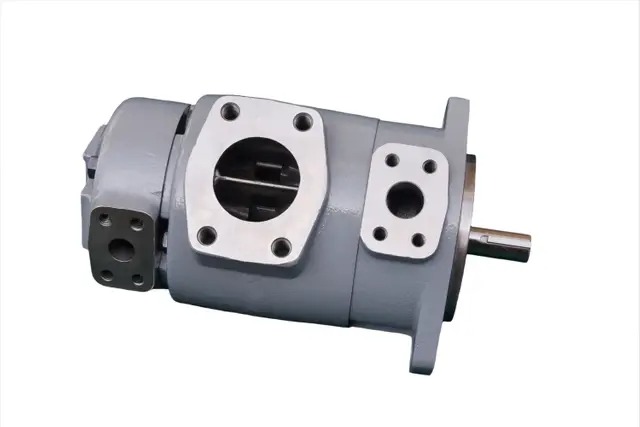
Let's look at a few real-world examples to see how the formula works in practice.
Suppose you have an industrial press using a low noise vane pump. You need to move 15 GPM at 2,000 PSI.
Theoretical HP: $(15 \times 2000) / 1714 = 17.5$ HP.
Adjusting for Efficiency: Assuming 85% efficiency, $17.5 / 0.85 = 20.58$ HP.
Result: You should choose a standard 20 HP or 25 HP electric motor.
You are using a 12v dc electric pump for a small lift. It moves 2 GPM at 1,500 PSI.
Theoretical HP: $(2 \times 1500) / 1714 = 1.75$ HP.
Adjusting for Efficiency: Small DC pumps often have lower efficiency (roughly 70%). $1.75 / 0.70 = 2.5$ HP.
Result: You need a DC motor capable of delivering 2.5 HP under load.
Even experienced technicians sometimes miss these nuances, leading to underpowered systems or premature hydraulic pump failure.
If your motor is barely strong enough, it will run at its limit constantly. This generates immense heat. In a high pressure system, heat thins the oil, which lowers the efficiency of the hydraulic pump, which in turn requires more power to maintain pressure. It's a vicious cycle.
Every valve, elbow, and foot of hose creates a pressure drop. If your cylinder needs 2,000 PSI to move a load, your hydraulic pump might actually need to produce 2,200 PSI to overcome plumbing resistance. Always calculate your HP based on the pump's outlet pressure, not just the work-piece requirement.
Is the pump running 24/7 or 30 seconds every hour? A low noise vane pump in a continuous industrial setting needs a motor with a high service factor. If you are using a two stage pump for a log splitter that runs for an hour on the weekend, you can be a bit more aggressive with your sizing.
Calculating how much horsepower you need for a hydraulic pump is a straightforward mathematical process, but it requires accurate inputs. By focusing on your required GPM and PSI, and factoring in the specific efficiencies of your variable displacement or two stage unit, you can ensure a long-lasting and cost-effective system.
Remember, the goal isn't just to "make it move." The goal is to create a system where the hydraulic pump and the prime mover work in their optimal "sweet spot." This reduces noise, lowers heat, and prevents the "sticker shock" of unnecessary energy bills.
1. Can I use a smaller motor if I reduce the RPM of my hydraulic pump?
Yes, but with a caveat. Reducing RPM reduces the GPM (flow). According to the formula, if GPM goes down, HP requirements go down. However, make sure your high pressure pump is rated for low-speed operation; some pumps rely on centrifugal force to extend their vanes and won't prime correctly at very low RPMs.
2. What happens if I under-power a variable displacement pump?
A variable displacement pump will try to maintain its set pressure. If the motor doesn't have enough HP, the pump will struggle to stroke up to provide flow. The motor will likely stall or overheat as it tries to provide the torque necessary to turn the pump against the internal pressure compensator.
3. Is a 12v dc electric pump less powerful than an AC pump?
Not necessarily, but they are limited by the current (amps) they can draw from a battery. A 12v dc electric motor can produce significant horsepower, but it will drain batteries very quickly. For high-duty cycles, AC power or internal combustion is usually preferred.
4. Why is my "low noise" pump getting louder?
Usually, increased noise indicates cavitation or aeration, but it can also be a sign of the motor "lugging." If the motor doesn't have enough horsepower to maintain a steady RPM under high pressure, the pump's internal timing can be disrupted, leading to increased vibration and noise.


