

Views: 325 Author: Site Editor Publish Time: 2026-02-17 Origin: Site


The Vickers vane pump remains a cornerstone of industrial hydraulic systems. Whether you are managing a manufacturing plant or designing heavy machinery, understanding the internal mechanics of this specific pump is vital for maintaining system efficiency. Known for their reliability and balanced design, these pumps convert mechanical energy from a motor into hydraulic fluid power through a series of rotating vanes.
In this guide, we dive deep into the mechanical principles, internal components, and the unique advantages that make a Vickers vane pump a preferred choice for high performance applications.
At its core, a Vickers vane pump operates on the principle of increasing and decreasing volume within a confined space. It is a positive displacement pump, meaning it moves a fixed amount of fluid for every revolution of its internal rotor.
The process begins with a slotted rotor connected to a drive shaft. Inside these slots sit rectangular vanes that are free to move radially. As the rotor spins, centrifugal force (often assisted by fluid pressure or springs) pushes the vanes outward against the inner surface of the cam ring.
The internal cavity of the Vickers vane pump is shaped like an ellipse or an offset circle. This eccentricity is the "engine" of the pump:
Suction Phase: As the rotor turns, the space between the vanes increases as they follow the contour of the ring. This creates a vacuum, drawing hydraulic oil through the inlet port.
Compression Phase: As the vanes continue to rotate toward the outlet, the volume between them decreases. This contraction forces the fluid out through the discharge port under pressure.
Unlike simple gear pumps, the Vickers vane pump provides a much smoother flow with significantly low noise levels, making it ideal for indoor industrial environments.
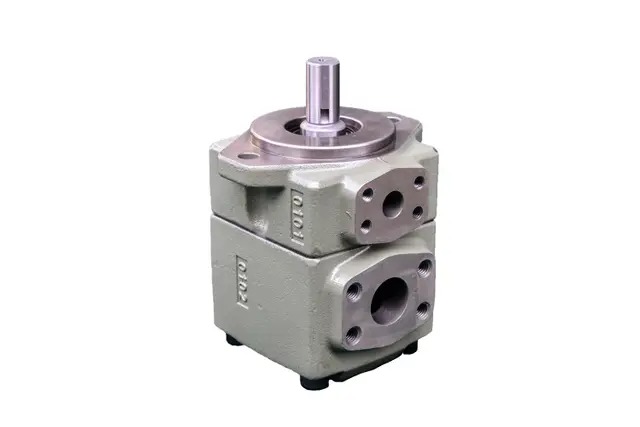
One of the most significant innovations found in a high performance Vickers vane pump is the intra-vane design. This technology allows the pump to operate at much higher pressures than standard vane pumps without causing excessive wear on the cam ring.
In a standard pump, the full discharge pressure acts on the bottom of the vane, pushing it against the ring with immense force. In a Vickers vane pump, a smaller "insert" or intra-vane is placed within the main vane.
Pressure Balancing: Only a portion of the pressure is applied to the vane tip.
Reduced Friction: This design allows the vane to maintain a tight seal against the ring while minimizing the friction that would otherwise lead to heat and premature failure.
| Feature | Standard Vane Pump | Vickers Intra-Vane Pump |
| Max Pressure | Moderate | High performance (up to 3000+ PSI) |
| Wear Rate | Higher at high RPM | Significantly lower |
| Efficiency | Drops over time | Maintains high volumetric efficiency |
By using this design, the Vickers vane pump can handle heavy duty tasks while extending the service life of the internal cartridge.
One common problem in hydraulic pumps is "unbalanced" loading, where pressure on one side of the shaft causes the bearings to wear out quickly. The Vickers vane pump solves this through a dual-chamber, balanced design.
Inside a single Vickers vane pump, there aren't just one inlet and one outlet. Instead, there are two of each, positioned directly opposite one another.
Symmetry: When fluid is being pressurized on the "top" of the rotor, an identical pressure is being created on the "bottom."
Vector Cancellation: These two opposing forces cancel each other out. The result is zero net radial load on the shaft bearings.
Because the bearings only have to support the weight of the shaft and the torque of the motor—rather than the hydraulic pressure of the system—they last thousands of hours longer. This makes the Vickers vane pump a staple in heavy duty applications like plastic injection molding and large-scale metal forming presses.
Depending on your machinery's requirements, you might encounter different physical layouts of the Vickers vane pump. Choosing the right one depends on whether you need a single steady flow or multiple independent circuits.
A single Vickers vane pump consists of one cartridge kit (one rotor, one ring, and one set of vanes) inside a housing. It is simple, easy to maintain, and perfect for driving a single hydraulic function.
In more complex systems, a double Vickers vane pump is used. This unit features two separate pumping cartridges driven by a single common shaft.
Independent Flows: You can use one side for high-pressure clamping and the other for high-speed cylinder movement.
Space Saving: It eliminates the need for two separate motors and couplings, significantly reducing the footprint of the hydraulic power unit.
Customization: You can mix and match cartridge sizes. For example, a double Vickers vane pump might have a large-volume front section and a high performance small-volume rear section.
Because of its low noise and high efficiency, you will find the Vickers vane pump in a variety of demanding sectors. It isn't just a general-purpose tool; it is a precision instrument for fluid power.
In factories, noise pollution is a major concern. The Vickers vane pump is remarkably quiet compared to piston pumps.
Die Casting: Providing the steady, high-pressure flow needed to inject molten metal.
Machine Tools: Powering the precision movements of CNC lathes and milling machines.
While many mobile machines use piston pumps, heavy duty Vickers vane pumps are often used for steering and auxiliary functions in:
Earthmoving Equipment: Providing reliable power for steering circuits.
Waste Management Trucks: Powering the compactors where high performance and durability are non-negotiable.
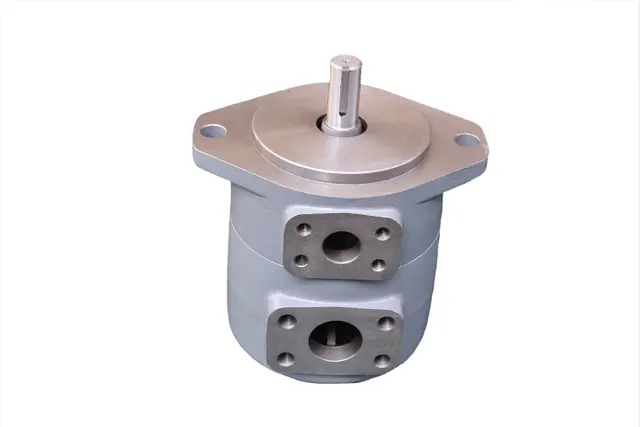
To keep your Vickers vane pump running at peak efficiency, you must understand the common failure points. Most issues aren't caused by the pump itself, but by the environment it operates in.
Cavitation: If the pump makes a high-pitched "marbles in a blender" noise, it is likely starving for oil. Check the inlet filters and ensure the oil isn't too thick.
Heat Generation: Excessive heat often points to internal leakage. If the vanes or ring are worn, oil slips past the seals, creating friction and heat.
Contamination: Vane pumps are sensitive to dirt. Small particles can get trapped between the vane and the ring, causing "scoring" or deep scratches.
One of the best features of the Vickers vane pump is its "drop-in" cartridge design. You don't have to replace the entire pump if it fails. You can simply remove the cover, pull out the old cartridge, and slide in a new one. This reduces downtime from hours to minutes.
As a dedicated player in the hydraulic industry, we take pride in our ability to deliver high performance solutions that meet the most rigorous global standards. Our factory is equipped with state-of-the-art CNC machining centers and testing rigs specifically designed to produce Vickers vane pump components with micron-level precision.
For our partners, it isn't just about buying a part; it is about securing a supply chain that ensures machine uptime.
Our Strength: We maintain a vast inventory of single and double Vickers vane pumps, ensuring fast lead times for urgent replacements.
Quality Assurance: Every pump we produce undergoes a full load-cycle test to ensure it meets heavy duty performance specs before it leaves our floor.
Global Reach: We support distributors and OEM manufacturers worldwide, providing the technical expertise needed to integrate these pumps into complex hydraulic circuits.
When you work with us, you are not just getting a product; you are gaining a technical partner committed to your operational success.
If you are debating between a gear pump, a piston pump, or a Vickers vane pump, consider the specific requirements of your application.
Gear pumps are cheaper but much louder and less efficient at high pressures. The Vickers vane pump offers a significant upgrade in low noise operation and volumetric efficiency.
Piston pumps can handle higher pressures (above 5000 PSI), but they are much more expensive and complex. For most industrial applications requiring 2000 to 3000 PSI, the Vickers vane pump provides the best balance of cost, simplicity, and high performance.
Understanding how a Vickers vane pump works reveals why it has remained an industry standard for decades. Its balanced design, low noise output, and the innovative intra-vane technology provide a level of reliability that few other pumps can match. Whether you need a single pump for a simple task or a double Vickers vane pump for a complex machine, these units deliver consistent, high performance results.
By maintaining clean fluid and choosing the right configuration for your pressure needs, you can ensure your hydraulic system operates smoothly for years to come.
1. What is the maximum pressure a Vickers vane pump can handle?
Most high performance models are rated for continuous operation up to 3000 PSI (210 bar), though this depends on the specific series and cartridge size.
2. Can a Vickers vane pump run in reverse?
Most are designed for a specific rotation (Clockwise or Counter-Clockwise). Running them in reverse can damage the internal vanes and prevent the pump from priming. However, the rotation can often be changed by flipping the internal cam ring during assembly.
3. How do I know if my Vickers vane pump cartridge is worn?
The most common signs are a loss of system speed (reduced flow), increased operating temperatures, and a change in the sound of the pump. If you notice these, it is time to inspect the cartridge.
4. Why is the Vickers vane pump considered "balanced"?
It features two internal pumping chambers positioned 180 degrees apart. This creates equal and opposite hydraulic forces on the shaft, which eliminates side-loading on the bearings.


